

EcoGrace
An "inside" view of nature

What do I mean by “EcoGrace?” And why do I recommend embracing this meaning?
Eco is not only expressed in the word “ecology” but also in the word “economy.” The Meriam-Webster dictionary says eco is derived from the Greek word oikos, which means household and includes the social and economic relationships of those within the home.
The word ecology was first used in 1875 as an English translation of the German word Ökologie. A new perspective in science, ecology describes how organisms interact with each other and their surroundings. The word economy originally referred to managing households but now refers to economic decisions affecting workers, consumers, manufacturers, banks, scientists, corporations and the governing bodies of cities, states, nations, and international organizations.
U. S. law requires that environmental policies be based on economic cost-benefit analysis. Economists estimate the social benefits and costs of a policy’s impact on the environment, using scientific predictions of the likely ecological consequences.
Economists and scientists view nature as if they are “outside.” In reality, however, all humans live “inside” nature and are completely dependent upon what we now identify as ecology.
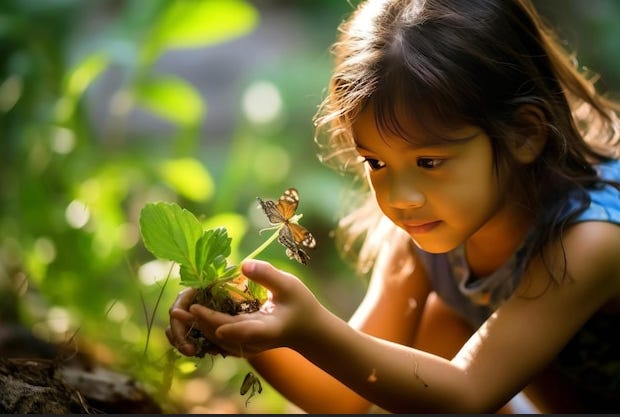
Eco emphasizes our complex relationships with all other life on earth, below its surface and in the atmosphere, as well as climate changes caused by global warming. Ponder for a moment what it might mean for you to explore an “inside” view of nature?
Grace is word that in the 12th century referred to “unmerited divine assistance given to humans for their regeneration or sanctification.” (Meriam-Webster Dictionary) Over the centuries grace as a noun has acquired related meanings, such as favor, mercy, and one’s bearing; and as a verb has been used to express conferring honor on an exceptional person.
In Christian cultures grace may simply mean saying a prayer before eating, but the New Testament repeatedly identifies grace as an undeserved gift expressing the Creator’s love.
The words of the song Amazing Grace are well known not only to Christians but to many others living in societies influenced by Christian traditions. I begin my 2024 book Verifying Spiritual Reality by quoting two verses from this spiritual:
Amazing grace! How sweet the sound
That saved a wretch like me!
I once was lost, but now am found,
Was blind, but now I see.
Through many dangers, toils, and snares,
I have already come;
’Tis grace hath brought me safe thus far,
And grace will lead me home.
These words were written by John Newton, who was making his living as the captain of a slave ship before experiencing the grace that led him to become a pastor and a prominent member of the London Anti-Slavery Society.
For Newton and other religious persons opposing slavery, grace was a spiritual force inspiring them to risk their lives in witness to the undeserved love of God for every human being.
Grace for Newton was saving, enlightening, transformative, and guiding. Not only generating courage and compassion but also the conviction that grace will lead us home. For Newton and many other Christians, having faith in the grace of God means facing the end of physical life with hope for a spiritual afterlife.
The apostle Paul writing closer to the death of Jesus than any other New Testament witness, uses a metaphor from nature to affirm and explain what the resurrection will mean for those who have been transformed by the grace of God: “What is sown is perishable, what is raised is imperishable. It is sown a physical body; it is raised a spiritual body.” (1 Cor 15:42-44)
EcoGrace concerns both natural and spiritual life choices. As metaphors, two natural cycles may guide us. The water cycle involves evaporation of water into the atmosphere where it becomes rain that nurtures all life on earth. And nature’s circular economy that transforms deceased organisms into new forms of life.

These undeserved gifts of nature provide the natural intelligence and creativity of the evolving life in the earth’s biosphere, which sustains every organism including each of us. Therefore, I urge everyone to acknowledge with gratitude the microbes, plants, fungi, and animals in nature with whom “we live and move and have our being.” (Acts of the Apostles, 17:28)