

Microalgae
Nature's Grace

The Foundation of Ocean Life
Microalgae, also known as phytoplankton, form the foundation of oceanic ecosystems. These microscopic organisms are responsible for nearly half of the global primary production—the process by which plants and algae convert sunlight into energy. They serve as the base of the marine food web, feeding everything from small zooplankton to giant whales (Hook). Without microalgae, oceanic biodiversity would collapse, leading to devastating consequences for marine life and global fisheries.
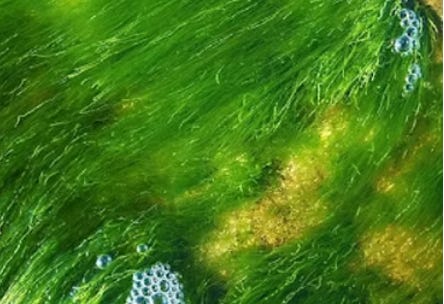
Beyond supporting marine food chains, microalgae play a crucial role in regulating water quality. Their photosynthetic activity generates approximately 50% of Earth’s oxygen, making them as important as terrestrial rainforests in maintaining atmospheric balance. Additionally, microalgae help stabilize ocean chemistry by absorbing excess nutrients like nitrogen and phosphorus, preventing harmful algal blooms and oxygen depletion.

Hook, B. (2023). Phenomenal phytoplankton: Scientists uncover cellular process behind oxygen production. Scripps Institution of Oceanography. Retrieved March 14, 2025, from https://scripps.ucsd.edu/news/phenomenal-phytoplankton-scientists-uncover-cellular-process-behind-oxygen-production
Nature’s Carbon Capturers: Microalgae and Climate Change
Marine microalgae are also powerful natural carbon sinks. Through photosynthesis, they absorb vast amounts of carbon dioxide from the atmosphere, transferring it into the ocean’s biological carbon pump. It is estimated that marine phytoplankton collectively fix about 50 gigatons of CO₂ every year—roughly half of all carbon fixation on the planet.
What makes microalgae particularly exciting in climate action is their efficiency in carbon assimilation. Unlike land plants, which are limited by factors such as soil quality and water availability, microalgae can grow rapidly in controlled environments, sequestering carbon at rates up to 50 times higher than terrestrial plants.

Recent research found that just one kilogram of cultivated algal biomass can remove about 1.83 kg of CO₂ from the atmosphere (Prasad). These figures highlight why scientists and environmentalists are exploring large-scale algae farms as a potential tool to combat climate change.
Prasad, R., Gupta, S. K., Shabnam, N., Oliveira, C. Y. B., Nema, A. K., Ansari, F. A., & Bux, F. (2021). Role of Microalgae in Global CO2 Sequestration: Physiological Mechanism, Recent Development, Challenges, and Future Prospective. Sustainability, 13(23), 13061. https://doi.org/10.3390/su132313061
Enormous Potential
Microalgae may be invisible to the naked eye, but their impact on our planet is immense. These tiny cells tie together the health of our oceans and the stability of our climate in profound ways.
By scaling up microalgae initiatives—from reef restoration nurseries to algae-powered carbon capture farms—we can work with nature to revive marine ecosystems and combat climate change simultaneously. The future of ocean sustainability might just hinge on embracing these microscopic powerhouses, proving that sometimes the smallest solutions can make the biggest waves.

Arif Gasilov, “Groundbreaking Study Confirms Algae Can Capture Carbon 50x Faster Than Trees, Offering a Powerful Climate Solution,” Seaside Sustainability, May 7, 2025,