

Tardigrades
Extraordinary Survivors

Most tardigrades, also known as “water bears,” are 1 mm (0.04 inch) or less in size, which is about the size of the period at the end of this sentence. They live in a variety of habitats worldwide: in moss, flowering plants, sand, and in fresh water and ocean environments.
The animals do not have organs for circulation or respiration. Instead, the tardigrade’s body cavity is filled with fluid that transports blood as well as oxygen. Tardigrades squeeze their muscles to pump nutrients and oxygen around their bodies.
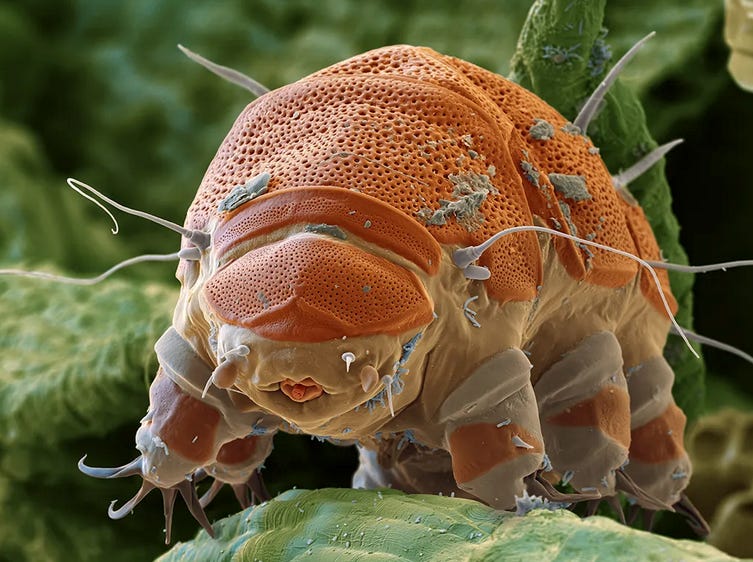
Most plant-eating tardigrades feed by piercing individual plant cells with the spearlike structures near their mouth and then sucking out the contents of the plant cell.
The most remarkable feature of the tardigrades is their ability to withstand extremely low temperatures and desiccation (extreme drying). Under stress they go into a state of suspended animation called the “tun” state—in which the body dries out and appears as a lifeless ball (or tun). In this state the tardigrade’s metabolism may decline to as little as 0.01 percent of its normal rate.
Animals kept for eight days in a vacuum and then placed for several hours in an enclosure at −272 °C (−458 °F) temperature, rapidly become active again when back in a more moderate temperature range.
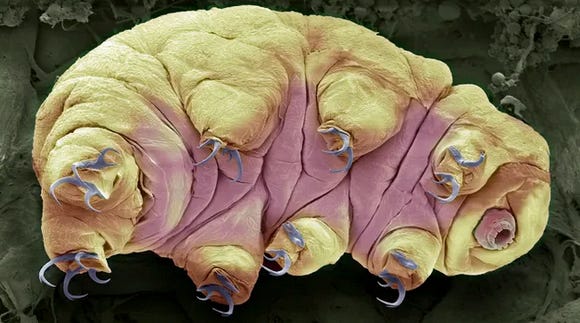
Recently scientists discovered that tardigrades protect themselves from UV radiation by making themselves fluorescent.
Tardigrades are able to survive as tuns for years. While in the tun state tardigrades are easily distributed by wind and water. Once back in an environment more congenial for life, they quickly revive.
Tardigrades have survived all five mass extinctions on Earth since they evolved about 500 million years ago. Tardigrades remind us that life can be incredibly resilient!
https://www.britannica.com/animal/tardigrade, March 3, 2026.
https://www.livescience.com/57985-tardigrade-facts.html, September 12, 2024.
Tardigrades are invertebrates that belong to the animal phylum Tardigrada. The first image is a scanning electron micrograph of a tardigrade. The second image is from the Science Photo Library / Alamy Stock Photo.